
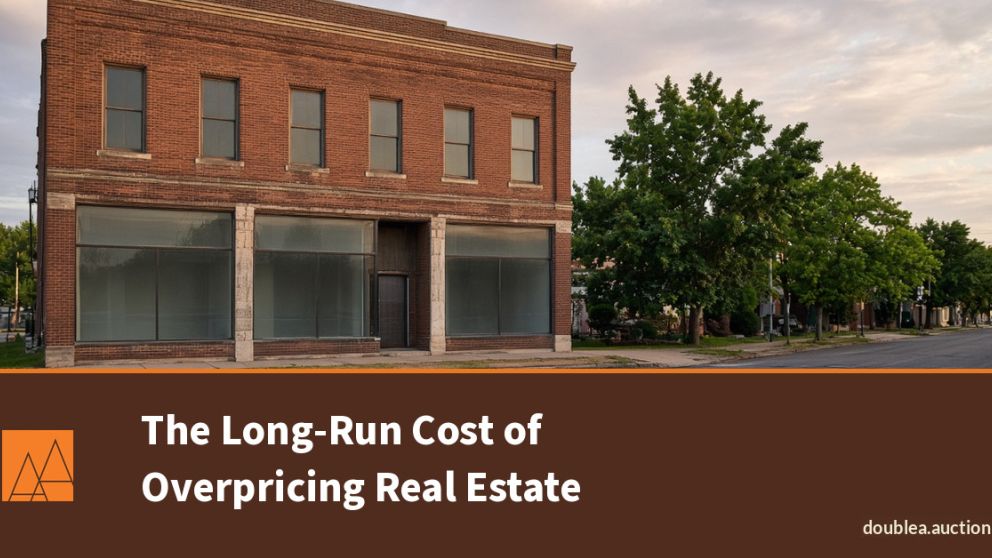
An asking price is not a store of value. It is a hypothesis about what a buyer will pay, and it is tested as soon as the property is offered to the market. When that hypothesis is set too high, the cost is rarely limited to a few extra weeks of waiting. In the long run, overpricing can consume carrying costs, waste the first and most valuable period of market exposure, and leave the seller with a lower price than a timely, well-exposed sale would have produced.
That is not an argument for giving the property away. It is an argument for not confusing a hopeful number with a marketing strategy. The seller still wants the strongest net result. The question is whether an inflated asking price protects that result or slowly erodes it.
Overpricing does not protect a property’s value. In the long run, it often consumes that value in carrying costs, a stale listing, and a lower sale price.
The Meter Keeps Running
While a property sits, the owner continues to pay for the privilege of holding it: real estate taxes, insurance, debt service, utilities, maintenance, security, and, if the building is vacant or underleased, the income that is not being earned. Those costs are easy to underestimate because they arrive as monthly bills rather than as a single line on a settlement statement.
Here is an illustrative example, clearly labeled as hypothetical and not a particular property. Suppose a small commercial building has monthly carrying costs of $4,000, made up of $500 in taxes, $250 in insurance, $2,750 in debt service, and $500 in utilities, maintenance, and security. If an asking price the market will not support keeps the property unsold for seven additional months, the cash outlay is $28,000. If the building is also vacant, and it would otherwise have produced $3,000 a month in rent, another $21,000 in income is forgone. None of those figures is a sale-price concession. They are the cost of time.
Time Has a Cost of Its Own
Even if the cash bills were zero, delay would still have a cost. A dollar received at a known closing date can be used to retire debt, fund another investment, or meet an obligation. A dollar expected at an uncertain later date is worth less, both because of the time value of money and because the owner continues to bear the risk that the market, the property, or the owner’s own circumstances will change.
Commercial owners often sell for a reason that has a calendar: a partnership dissolution, a refinance that did not materialize, a relocation, an estate, or a desire to stop carrying an underused asset. An open-ended listing that has to be reduced, relisted, or explained does not serve that calendar.
A Stale Listing Sends the Wrong Signal
The first weeks of market exposure are when the largest number of potentially interested buyers typically see the property as new. If the asking price keeps those buyers from touring or from writing an offer, that audience is not held in reserve. Many of them simply move on.
What remains is a listing that has been on the market long enough to raise a question the seller never intended to ask: what is wrong with it? Buyers and their advisors treat time on market as information. A long marketing period can suggest deferred maintenance, a difficult negotiation, an unresolved title or environmental issue, or simply a price the market has already rejected. Even when none of those things is true, the signal still has to be overcome.
Redfin, in a March 2026 analysis of listings on its site, reported that 52.2% of February’s home listings had been on the market at least 60 days without going under contract—the highest February share since 2019. The same report noted that overpricing a home by 10% or more can increase time on market by more than a month. Those figures come from the housing market, not a commercial index, but the mechanism is the same: an asking price the market will not support lengthens the marketing period, and a long marketing period becomes part of the property’s story.
Price Cuts Often Chase the Market Down
The usual response to a quiet listing is a price reduction, then another. Each cut is an attempt to find the price the market would have tested at the start. In the meantime, the listing has already been seen, passed over, and mentally filed as overpriced. Subsequent reductions can look like distress even when the owner is simply correcting an earlier guess.
That pattern is not abstract. Consider a rural Southside Virginia property that came on the market in the spring at a mid-$400,000 asking price. After a series of reductions, it was later offered at $299,000. As of this writing, it remains unsold. From May to late November is about seven months of carrying costs—taxes, insurance, utilities, maintenance, and debt service, if any—plus the time value of the capital that could already have been in hand. That seven-month holding period is a labeled estimate, not a claim about any one owner’s actual bills.
The market around that listing also moved. In May 2026, the 30-year fixed rate in Freddie Mac’s Primary Mortgage Market Survey ranged from 6.36% to 6.53%. As of November 19, it averaged 7.28%. On-highway diesel, as reported by the U.S. Energy Information Administration, ran up after May as well: the U.S. average was about $5.60 a gallon in May, peaked above $6.50 in September, and, in the week of November 23, was $5.695, still a little above the May average after that summer-and-fall increase. A more realistic asking price in May would have given the property its best chance to sell before financing costs rose and the listing grew stale. Waiting did not preserve the original ask. It used up the selling season.
What the Data Show
The cost is not only time. Listings that linger, and listings that have to be reduced, tend to sell for less relative to the original ask—and, in careful comparisons, for less than otherwise similar properties that sold sooner.
Realtor.com’s June 2026 research on the path from list price to sale price found, after controlling for market conditions (the year, month, and region of the sale), new-construction status, and property type, that homes closing four weeks after listing sold with a sale-to-latest-listing-price ratio 1.8 percentage points higher than the average home sold in that month. The worst results came when the home sold 18 weeks after listing, when that ratio was 1.3 percentage points lower than the average. The homes with the best performance relative to list price had gone under contract in the first two weeks. The same study noted that homes sitting on the market for a long time are less likely to sell above their initial listing price, often because that listing price was too high.
That pattern is not new. A 2002 study in Real Estate Economics, by John R. Knight, concluded that mispricing the home in the initial listing is costly to the seller in both time and money, and that homes with large percentage changes in list price take longer to sell and ultimately sell at lower prices.
These studies describe residential sales. Commercial properties are not the same market, and a given building will not move by 1.8 percentage points because a housing study says so. The lesson that does transfer is the one a commercial owner can test against a pro forma: an asking price the market will not support extends the holding period; the holding period has a cash cost; and a stale or repeatedly reduced listing is a weaker negotiating position than a property that meets the market while it is still new to buyers.
A Defined Decision Date Avoids the Trap
None of this is an argument that an auction is a way to sell cheaply, or that a competitive sale is a discount from some higher “true” value. An auction is a method of sale and a way of discovering price. Whether the result reflects the market depends on exposure, the information buyers receive, the parties’ motivations, and the terms—not on the fact that bidding was used.
What a well-managed auction can do is spare the seller the particular trap of an asking-price listing that starts too high. Instead of publishing one number and then chasing the market down, the owner offers the property during a defined marketing period, under published terms, and on a set decision date. Interested buyers complete their investigation against the same deadline. The price is established by competition among those buyers, not by a sequence of reductions that advertise yesterday’s miss.
The seller still has work to do: a clear file, a realistic view of use and condition, and enough time to put the opportunity in front of the people who have a reason to compete for it. The objective is the strongest net result after carrying costs, timing, and risk—not the highest number that can be typed onto a flyer. Before deciding how to sell, be honest about:
- The monthly cost of continuing to hold the property, including vacancy if applicable.
- How long the owner can actually wait, and what may change in the market during that time.
- Whether the intended asking price is supported by recent, comparable transactions and by the property’s current use and condition.
- What a series of price cuts would signal to the same buyers the listing is trying to attract.
Let the Market Establish the Price
Andy Austin, MAI, CCIM, CAI, AARE, AMM, and the Double A Auction & Realty team help commercial property owners evaluate the asset, understand the true cost of holding it, define the seller’s objectives, prepare bidder information, market the opportunity, and conduct a competitive auction under clear terms.
A first conversation can determine whether the auction method fits the property and the owner’s timing. You do not need to have every detail resolved before beginning.

Can’t make it to our auction?
Download our mobile bidding app to your smartphone, and bid from wherever you need to be. Works for both Apple and Android.