
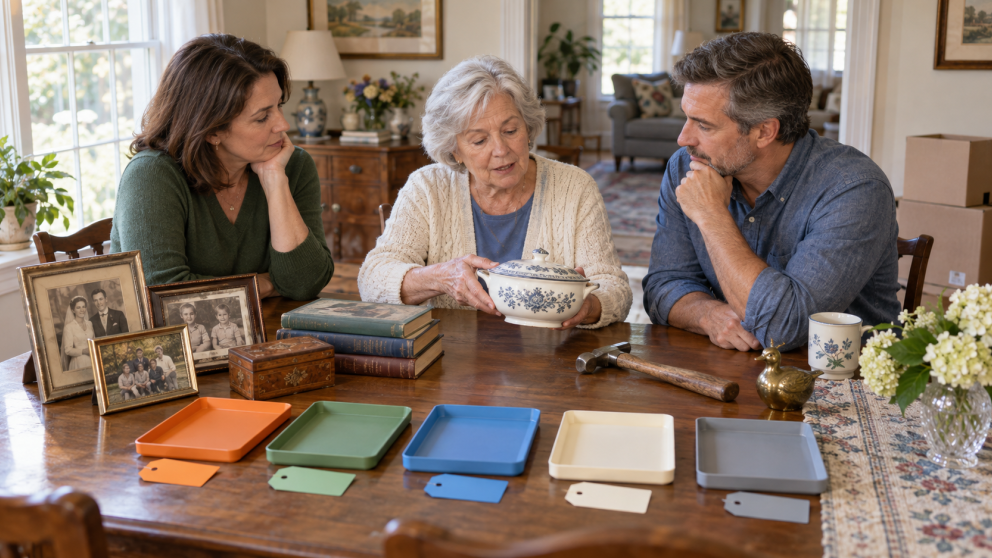
Sorting a lifetime of belongings is often the most emotional and time-consuming part of downsizing. Every room contains easy decisions, uncertain decisions, and objects connected to people, places, and stages of life that cannot be reduced to a simple question of value.
The process becomes more manageable when each item has one of five destinations: keep, give away, sell, donate, or discard. The goal is not to make every decision quickly. It is to use a consistent method so the family can make progress without losing important property or exhausting the homeowner.
Do not begin by asking, “How do we empty this entire house?” Begin with one room, five categories, and a clear place for items that require more thought.
Keep What Supports the Next Home
The “keep” category should begin with the next living arrangement. What furniture will fit? Which kitchen items, clothing, tools, and household goods are used regularly? Which possessions will make the new space feel familiar and comfortable?
An item is a strong candidate to keep when it meets one or more practical tests:
- It will have a specific place and purpose in the new home.
- It is used regularly or would be difficult to replace.
- It carries genuine personal meaning and remains important to the homeowner.
- Its size, condition, and moving cost are reasonable for the new space.
Keeping an item because there is no time to decide simply transfers the decision to a storage unit or a family member’s garage. A smaller group of useful and meaningful possessions is usually more comforting than a new home crowded with boxes that may never be opened.
Give Items to Family With a Clear Process
Family belongings can carry different meanings for different people. A valuable dining set may attract little interest, while a handwritten recipe, workshop tool, or inexpensive holiday decoration may matter deeply to a child or grandchild.
Ask family members what they would like rather than assuming. Photographs or a shared list can help relatives who live far away participate. Establish a reasonable response deadline and decide in advance how conflicts will be handled. The homeowner’s wishes should guide the process whenever possible.
A gift is not complete until the recipient removes or arranges delivery of the item. Labeling furniture for someone who cannot accept it does not reduce the work. Confirm that the recipient has the space, transportation, and intention to take possession by a specific date.
Sell What Has a Real Market
Financial value is not determined by age, original cost, or sentimental importance. It depends on condition, demand, rarity, location, and the practical cost of marketing and transferring the item. Some collections, tools, equipment, jewelry, firearms, vehicles, antiques, and quality household goods may attract meaningful competition. Other items may sell best when grouped into useful lots.
Before selling or discarding anything that may have unusual value, ask an experienced professional to review it. At the same time, keep expectations realistic. An object can be well made and personally important without having a large resale market.
A personal-property auction can address many categories in a single organized event, particularly when the home includes collections, a workshop, business assets, vehicles, or a substantial household. The sale method should fit the property rather than forcing every object into the same approach.
Donate Useful Items That Others Can Use
Donation can be a satisfying destination for clean, functional property that will not be moved, claimed by family, or included in a sale. Furniture, clothing, kitchenware, books, and household supplies may be useful to charitable or community organizations, but acceptance policies vary.
Contact the organization before loading or delivering items. Ask what it accepts, whether pickup is available, and what condition is required. If documentation or possible tax treatment matters, keep appropriate records and consult a qualified tax professional rather than making assumptions about deductibility.
Discard Responsibly and Protect Private Information
Some items are broken, unsafe, incomplete, badly damaged, or unsuitable for donation. Letting them go is part of completing the transition. Recycle when practical, and follow local requirements for paint, chemicals, batteries, medications, electronics, and other materials that should not enter ordinary household trash.
Papers containing account numbers, medical information, Social Security numbers, signatures, or other private information should be separated for secure destruction. Before disposing of records, confirm what must be retained with the appropriate legal, tax, financial, or medical professional.
Create a Temporary “Undecided” Category
Not every choice should be forced during the first pass. Set aside one clearly limited area for uncertain items. When that space is full, return to it before creating another. This gives the homeowner time to think without allowing uncertainty to spread back through the entire house.
Work in short sessions and complete one small area at a time. Record decisions, label items clearly, and remove completed categories from the room promptly. Visible progress builds confidence and reduces the chance that the same possessions will be reconsidered repeatedly.
You do not need to sort every possession before asking for help. An early walkthrough can identify valuable property, likely sale categories, donation options, cleanout needs, and the order in which the work should proceed.
You Do Not Have to Sort Everything Alone
Double A Auction & Realty helps seniors and their families coordinate the complete transition. We can assist with the next-home search, real estate, personal property or business assets, cleanout needs, and the move to the new location.
You do not need to solve the entire project before beginning. We can help identify the next practical step and build an orderly plan around the homeowner’s priorities.

Can’t make it to our auction?
Download our mobile bidding app to your smartphone, and bid from wherever you need to be. Works for both Apple and Android.